
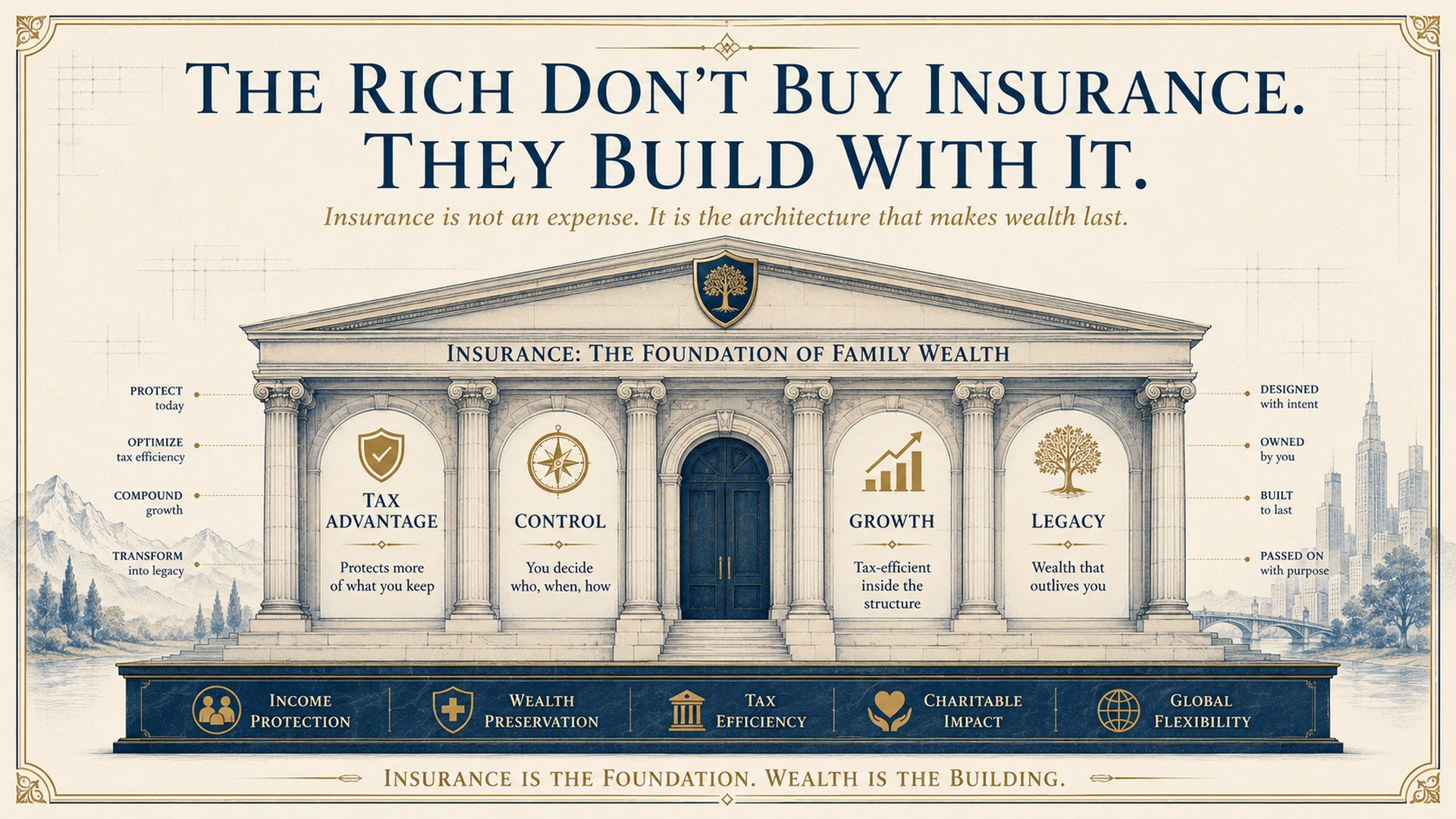
The Rich Don't Buy Insurance. They Build With It.
There is a quiet conversation that happens in family offices from Geneva to Singapore to Dubai. It is not the subject of investment conferences. It is the quiet agreement, passed from one generation of advisors to the next, about a product the wealthy have always understood differently from everyone else. That product is life insurance. They were never buying protection. They were building architecture.
The lesson of 1947
When the Tolani family lost a great deal at the partition of India, the assets that could be taken were taken, and the property that could not be moved was gone. The insurance policies held. They were liquid when nothing else was, accessible when every other asset had frozen. That lesson was never forgotten. In the generations that followed, the family did not just hold insurance. They ran insurance companies, and came to understand the product from the inside.
This product was not built for you
The modern insurance market was not built for ordinary families protecting ordinary incomes. It was built in 1688, in Edward Lloyd's London coffeehouse, by merchants protecting ships whose cargo was worth more than most people earned in a lifetime. The principle has never changed. The wealthy insure what they cannot afford to lose. The question they ask is not what the product costs, but what it costs to be without it.
Rockefeller and Vanderbilt: one decision, two destinies
Two American fortunes, the same era, the same tax laws. The Vanderbilt fortune largely dissipated within three generations, divided and eroded with no structural protection in place. The Rockefeller fortune endures across six, anchored by what historians call the Rockefeller Waterfall: permanent life insurance held inside irrevocable trusts, each death benefit flowing back to buy new policies on the next generation. The trust was never spent down. It was replenished, generation after generation.
Capital when the bank says no
Life insurance has also been a source of capital when conventional lenders refused. In 1953 Walt Disney borrowed against the cash value of his policy to seed Disneyland, when no bank would fund it. During the Great Depression, J.C. Penney borrowed against his policies to make payroll and keep his company alive. The cash value inside a permanent policy is a private reserve: accessible without a credit check, without the approval of a bank that may change its mind.
Asset rich, liquid poor
Every wealthy family eventually meets the same condition. Everything they own has value, and none of it can be moved quickly without cost or loss. In a downturn the property has no buyer at the right price, selling the portfolio locks in the loss, the business cannot be liquidated on a short timeline, and the bank has quietly revised its risk appetite. The one asset that does not reprice, does not become illiquid, and does not need anyone's approval is the cash value inside a life insurance policy.
What the research confirms
Across more than three thousand wealthy families, seventy percent of wealth transitions fail by the second generation and ninety percent by the third. Only three percent of those failures came from poor investments or legal structures. The rest came from unprepared heirs and broken family communication. The money was there. The architecture to transfer it was not. At the other extreme, Florentine families with structural preservation mechanisms in place in 1427 held their relative economic position six hundred years later.
Three things to take away
01. Life insurance was designed by the wealthy to protect wealth. The mass-market framing of it as a death benefit product is historically incomplete.
02. The families that stayed wealthy for six generations used permanent life insurance not as a payout at death but as living financial architecture: liquidity, generational transfer, and uncorrelated certainty when every other asset class was under pressure.
03. Ninety percent of family wealth fails by the third generation. The families who broke that pattern did not do so by chance. They did so by design.
The first generation builds the wealth. The second grows it. The third inherits it. The fourth is shaped entirely by whether the first three built the architecture alongside the capital.
See how Tolani Flow® applies this → · Read the full research paper ↗
Read the research behind the framework.
Get the 37-page Tolani Family Office research paper on Private Placement Life Insurance, purpose, advantages, §7702 compliance architecture, and the Tolani Flow® model. Free.