
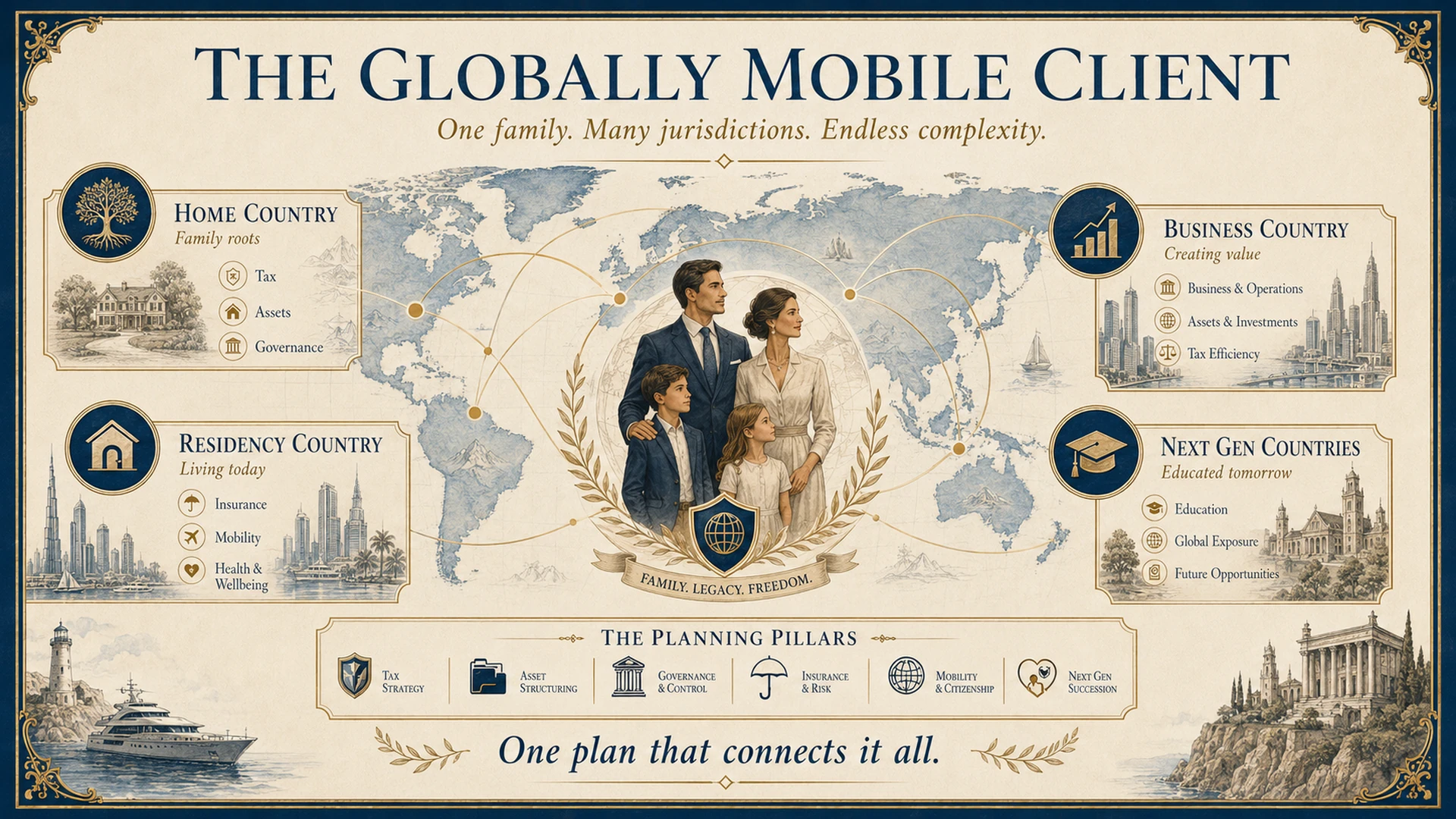
The Globally Mobile Client
A New Framework Every Financial Planner Needs
I want to tell you about a conversation I had several years ago that changed the way I think about what financial planners actually do.
A client, let's call him Rajan, sat across from me in my Dubai office. He was 54 years old, held an Indian passport, had lived in the UAE for nineteen years, and had recently activated a Caribbean Citizenship by Investment programme for himself and his family. His son was at university in the UK. His daughter had just married and moved to Canada. His operating business ran from Singapore. His investment portfolio was managed by a private bank in Switzerland. He owned commercial property in Dubai and residential property in Mumbai.
He had four advisors: a private banker in Zurich, a tax attorney in London, an insurance broker in Dubai, and a corporate lawyer in Singapore. None of them had ever spoken to the other.
Rajan leaned forward and asked me one question: "If I died next week, what would actually happen to my family?"
I spent the next four hours helping him understand the answer. It was not a good answer. His Singapore portfolio had no named beneficiaries, probate there can take 18 to 36 months. His Mumbai property would enter an Indian succession process that none of his children understood. His Caribbean citizenship had been structured in isolation, with no integration into the rest of his estate. His Swiss portfolio was sitting in a tax position that made no sense for a UAE resident. And nobody, not one of his four advisors, had ever looked at all of this together.
Rajan is not an unusual client. In my experience across the GCC, Southeast Asia, and South Asia, he is the rule, not the exception. The globally mobile client is sitting in advisors' offices right now, often unidentified, almost always underserved.
This article is for the financial planners who want to serve them properly.
The Client the Financial Planning Profession Has Not Caught Up With
The financial planning profession was built for a world that no longer exists for a significant and growing number of clients. The planning frameworks most of us learned, the risk tolerance questionnaire, the single-jurisdiction retirement model, the domestic estate plan, were designed for clients whose lives take place in one country.
The globally mobile client's life does not take place in one country. It takes place across three, four, sometimes six jurisdictions simultaneously. And the number of such clients is growing faster than the profession is adapting to serve them.
Consider what is happening in the market right now. More than 40 Residency and Citizenship by Investment programmes are active globally, from the UAE Golden Visa to Singapore's Global Investor Programme to the Caribbean CBI corridor. The Knight Frank Wealth Report (2024) documented that 19 percent of ultra-high-net-worth individuals were actively pursuing second citizenship or alternative residency in 2024 alone. The Boston Consulting Group estimates that the global intergenerational wealth transfer between 2024 and 2048 will exceed USD 84 trillion, and the families receiving that wealth are dramatically more geographically dispersed than the generation that created it.
A 2023 UBS survey of 230 family offices globally found that 67 percent had family members living in more than two countries, and 43 percent held assets in five or more jurisdictions. For these families, the conventional estate plan, a single will, a single trust jurisdiction, a single applicable succession law, is not just inadequate. It is structurally wrong.
The financial planner who has not updated their framework for this client is not failing through incompetence. The profession simply has not yet produced a coherent, practical model for serving globally mobile clients. This article proposes one.
The Five Symptoms of the Multi-Jurisdictional Problem
Before a financial planner can solve the globally mobile client's problem, they need to be able to see it clearly. In my practice, working with families across the GCC, Southeast Asia, and South Asia over more than two decades, I have found that the problem consistently shows up in five recognisable forms. I call them the five symptoms.
Table 1. The Five Symptoms of the Multi-Jurisdictional Problem. Each symptom is preventable with the right structure in place before the event.
The critical insight about these five symptoms is that none of them are exotic edge cases. Every one of them is a predictable, preventable outcome that arises from a single underlying cause: the client's life became multi-jurisdictional and the planning did not.
The question to ask every client at the start of an engagement is not 'What is your risk tolerance?' It is 'How many countries does your family touch?' The answer to the second question determines whether the standard planning framework is sufficient or whether a completely different approach is needed.
A Framework That Travels With the Client
The core insight that has guided my practice over the past two decades is deceptively simple: for a globally mobile client, the planning framework must be portable. Not the investments, those can be jurisdiction-specific. Not the legal structures, those necessarily vary by country. The framework itself, the architecture that connects protection, structure, and governance, must be designed from the outset to function regardless of where the client is resident at any given moment.
I think of this as a three-layer architecture. Each layer addresses a different constraint that multi-jurisdictional clients face, and all three layers must be in place and connected before the plan is complete.
Layer one is income protection and liquidity. Before anything else, every income-generating member of a globally mobile family should have two things in place. First, a life insurance policy calibrated to at least ten times annual income, held in trust to keep it outside the taxable estate, that provides a death benefit payable regardless of which country the policyholder is resident in at the time of death. Second, a guaranteed annuity income floor that cannot be disrupted by market conditions, residency changes, or family dynamics. Globally mobile UHNW clients frequently have no reliable state pension entitlement in their country of residence. The annuity is not a supplement to a social security floor. It is the floor.
Layer two is structural tax efficiency and estate transfer. Once the income protection layer is in place, the client's investment portfolio should sit inside a structure that achieves three things simultaneously: tax-deferred accumulation during the client's lifetime, income-tax-free transfer to beneficiaries at death, and portability across the client's residency transitions. A well-designed Private Placement Life Insurance structure, issued from the right jurisdiction, does all three. It also bypasses probate entirely, the death benefit goes directly to named beneficiaries, outside the estate and outside the courts, regardless of which jurisdiction the client was resident in at death. This is the structural solution to probate paralysis, forced heirship collision, and tax leakage at transition, all at once.
Layer three is governance and coordination. The most technically sophisticated protection and structure layers in the world will gradually become incoherent if no one is responsible for keeping them aligned. Layer three is the coordinating function, the single advisor or family office professional with an explicit mandate to review the entire structure annually, to assess whether any residency changes have created portability issues, and to ensure that the attorney, the tax advisor, the insurance specialist, and the financial planner are working from the same picture. This is the direct solution to the advisory fragmentation problem. The planner who occupies the Layer 3 coordinating role is not a product seller. They are the architect of the client's integrated wealth structure.
The Ferreira Lesson: What Structure Drift Costs
I want to share a real example of what happens when this framework is absent, not in a catastrophic single event, but in the quiet, cumulative way that wealth actually erodes.
The Ferreiras were a successful third-generation Brazilian-Portuguese family with assets across Brazil, Portugal, and the United States. In 2021, they sold a significant portion of their Brazilian agribusiness to a strategic acquirer. It was a good deal, commercially sound, well-timed, transformative for the family's net worth.
What followed the sale was eighteen months of preventable pain. Their Brazilian holding structure had not been reviewed since 2016. The sale triggered a tax liability significantly higher than anticipated because a structural reorganisation that had been discussed but never executed would have reduced it substantially. Their U.S. assets were held through entities that created unintended estate tax exposure for their U.S.-resident family members, a consequence of an advisory recommendation made in 2018 that was never integrated with the broader structure. Their Portuguese assets were subject to a succession regime that conflicted with the Brazilian estate plan in two material respects. The conflict had existed for years. No one had identified it because the advisors in each jurisdiction did not know about the other.
The additional tax paid, the legal costs, and the opportunity cost of the delay conservatively totalled USD 8.5 million. As the patriarch said to me at the conclusion of the remediation: "We paid eight and a half million dollars to understand why this matters. You are now offering us the same lesson for considerably less. I would encourage whoever reads this to take the cheaper path."
The Ferreiras were not negligent. They had advisors. They paid attention to their business. They simply had not built the coordinating infrastructure that would have caught the drift before it became a disaster. Every year without a cross-jurisdictional review is a year of accumulated vulnerability. Every advisor working in isolation is another gap in the map.
Four Practical Steps for Financial Planners
The globally mobile client framework is not a product to sell. It is an advisory approach to adopt. Here is how to put it into practice immediately.
Map every client's jurisdictional footprint. Take your top 25 client relationships and ask systematically: how many countries does this family touch, through residency, citizenship, asset ownership, children's location, or business incorporation? Assign each client a "jurisdictional count." Any client touching three or more jurisdictions should be flagged for a full multi-jurisdictional review. In my experience, advisors are consistently surprised by how many clients qualify once they ask this question explicitly and systematically.
Treat every RCBI event as a mandatory planning trigger. Golden Visa activations, CBI citizenship grants, changes of principal residence, these are not background administrative events. They are the moments when existing structures are most likely to be inadequate, and when clients are most open to comprehensive planning conversations. Build a protocol that ensures any client who mentions a residency or citizenship change receives an immediate review of their insurance portability, their estate planning assumptions, and their tax position in the new jurisdiction.
Establish the coordinating mandate explicitly. The most valuable thing a financial planner can do for a globally mobile client is not to recommend a product. It is to become the professional who holds the complete picture and coordinates across all the specialists. This means having an explicit conversation with the client: I am not just your financial advisor. I am the coordinator of your entire structure. I need to know about every significant decision in every jurisdiction, before it happens, not after. Clients who understand this mandate respond to it with relief. It is the conversation no other advisor has been willing to initiate.
Quantify the cost of the status quo. The most powerful tool in the globally mobile client conversation is not a product illustration. It is a simple question: if your estate went through probate in each jurisdiction where you hold assets tomorrow, how long would it take, and how much would it cost? For most multi-jurisdictional clients, the honest answer to this question creates the urgency for everything else. The Ferreira family's USD 8.5 million lesson, the Mehta family's eighteen-month Singapore probate freeze, these are the numbers that land. Present the cost of the client's current structure alongside the cost of fixing it, and the conversation changes entirely.
The Opportunity That Is Hiding in Plain Sight
The globally mobile client is not a niche market. They are an expanding segment of the affluent population that the financial planning profession is structurally underserving, not because planners lack the skill, but because the profession has not yet developed a coherent framework for approaching them.
The framework described in this article is not complicated. It does not require the financial planner to become a tax attorney or an insurance actuary. It requires the planner to ask different questions at the start of every client engagement, to identify multi-jurisdictional complexity when it is present, and to position themselves as the coordinating professional who ensures that the specialist layers are working together rather than in isolation.
That coordinating role, the professional who holds the family's complete picture across every jurisdiction, is the highest-value, least-replicable service a financial planner can offer an internationally mobile client. It is also the role that every one of those clients needs and almost none of them currently has.
Start with the map. Ask every client how many countries their family touches. The answer will tell you everything about whether the standard planning framework is sufficient, and which clients are waiting for someone to finally see the full picture of their lives.
Read the research behind the framework.
Get the 37-page Tolani Family Office research paper on Private Placement Life Insurance, purpose, advantages, §7702 compliance architecture, and the Tolani Flow® model. Free.