
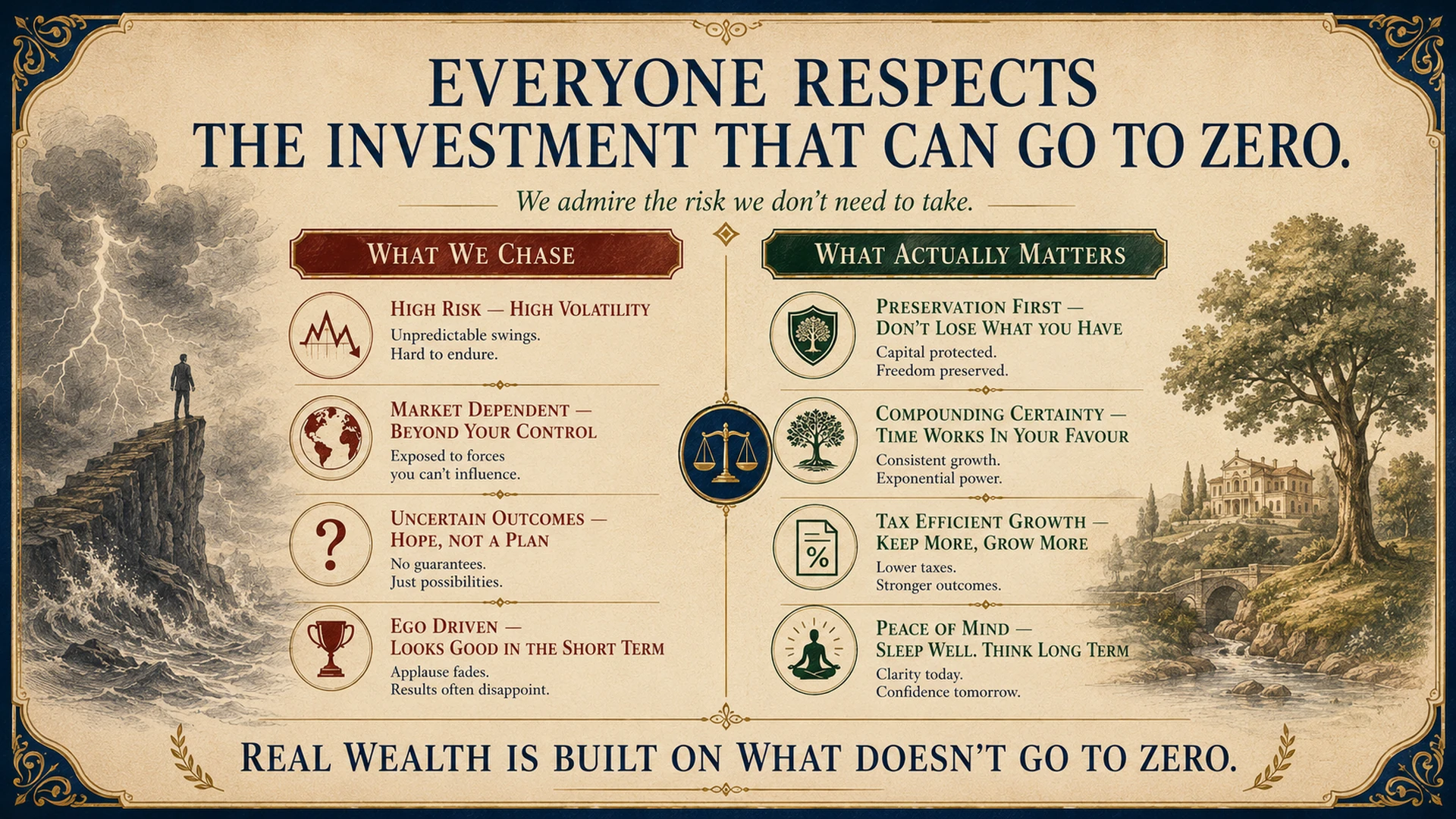
Everyone Respects the Investment That Can Go to Zero.
People will happily tell you about the crypto they bought at the peak, or the stock that went nowhere for three years. Ask about their life insurance policy and watch the posture shift. The product that guarantees its outcome, that does not need a market to cooperate, that has delivered on its promise for over three hundred years, is the one that makes educated, sophisticated people quietly uncomfortable. That snobbery has cost more families more money than any market crash ever has.
The salesperson problem
Ask why people feel dismissive about life insurance and they rarely say they analysed it and found it structurally inferior. They say it is because of how it gets sold. Yet nobody looks down on a pension because of how it was sold, or dismisses a trust because the lawyer was aggressive. Somewhere along the way, life insurance got judged by the person selling it rather than the outcome it delivers. That is not sophistication. It is snobbery dressed up as taste.
The contradiction nobody examines
People put money into equities that can lose half their value in a correction, accept the fees and the risk, and call it building wealth. They then look at a permanent policy that cannot go to zero, compounds on a guaranteed basis, and pays precisely when every other asset is under stress, and say they are not sure it is right for them. This is not a financial opinion. It is optimism bias: the comfortable belief that catastrophe happens to other people.
Prince, Aretha, and the cost of waiting
Prince died in 2016 with an estate of about 156 million dollars and no will, no trust, no plan. Six years of probate, a dispute with the tax authorities, and nearly thirty claimants followed. Roughly half the estate was lost to taxes, fees and friction. Aretha Franklin died in 2018 with up to 80 million dollars and no formal will. Her sons spent years in court against a federal tax bill of nearly 8 million. A simple insurance trust, structured in advance, would have changed both outcomes. Later arrived before the conversation did.
The product does not have an image problem
Stripped of every piece of marketing language, life insurance is a contract that guarantees a specific outcome at the moment it is most needed and least available from any other source. It compounds without market risk, transfers without probate, and pays without negotiation. The reason it gets looked down on is not what it does. It is how it makes people feel to think about it, because it requires a confrontation with mortality.
The product the wealthy use most
The families that have kept wealth across centuries hold life insurance as a central pillar of the architecture, not an afterthought. The Rockefellers built a waterfall around it. The Hearsts sustained a media empire with it. The merchant class of seventeenth-century London created the modern insurance market because they had something worth protecting. The wealthy have never been embarrassed to own it. They have been too busy using it to notice what everyone else thinks.
Three things to take away
01. The snobbery around life insurance is a psychological condition, not a financial opinion. Optimism bias, association with aggressive selling, and the discomfort of confronting mortality are not reasons. They are excuses with financial consequences.
02. The cost of not planning is not theoretical. Prince lost roughly half of a 156 million dollar estate. Aretha Franklin's faced an 8 million dollar tax bill and years of disputes. Avoidance is always more expensive than preparation.
03. The product that guarantees its outcome is the one most people dismiss. The families who understood otherwise are the ones still standing.
Everyone respects the investment that can go to zero. Nobody respects the one that cannot. That gap in perception is the gap between the families that stay wealthy and the families that wonder what happened.
See how Tolani Flow® applies this → · Read the full research paper ↗
Read the research behind the framework.
Get the 37-page Tolani Family Office research paper on Private Placement Life Insurance, purpose, advantages, §7702 compliance architecture, and the Tolani Flow® model. Free.